
If you’ve ever stopped to wonder, “Just how long is a school bus anyway?” we have also been in that curiosity before we knew the actual reality of things. It’s one of those things you see every day – dodging one on a narrow street, squeezing into a crowded bus lane, but when was the last time you actually took the time to measure it in your head? Understanding the length of a school bus is more than just idle curiosity – it’s down-to-earth, practical knowledge too. I mean, let’s get real: when you’re used to cars, even what might be considered a “small” school bus is quite enormous.
School buses are available in many different sizes, and everything depends on the type of bus, the number of children it can carry, and the purpose it is to be used. The kinds of buses that are more common are between 35 and 45 feet in length, while the smaller buses are in the range of 20-30 feet. Widths are normally about 8–8.5 feet, and they come in at a height of approximately 10–11 feet. But if you really want to get a good feel for the different types of school buses out there – including passenger capacity and how they compare to your average family car – then there’s a lot more to learn.
How Long Is a School Bus – The Quick Answer
What is the length of a school bus? So, to get down to the point, the majority of regular-sized school buses will be 35-45 feet long, whereas the buses that will be shorter will be approximately 20-30 feet long. Its size will actually depend on the type of bus you are referring to, the number of passengers the bus can carry, and the specification of the manufacturer.
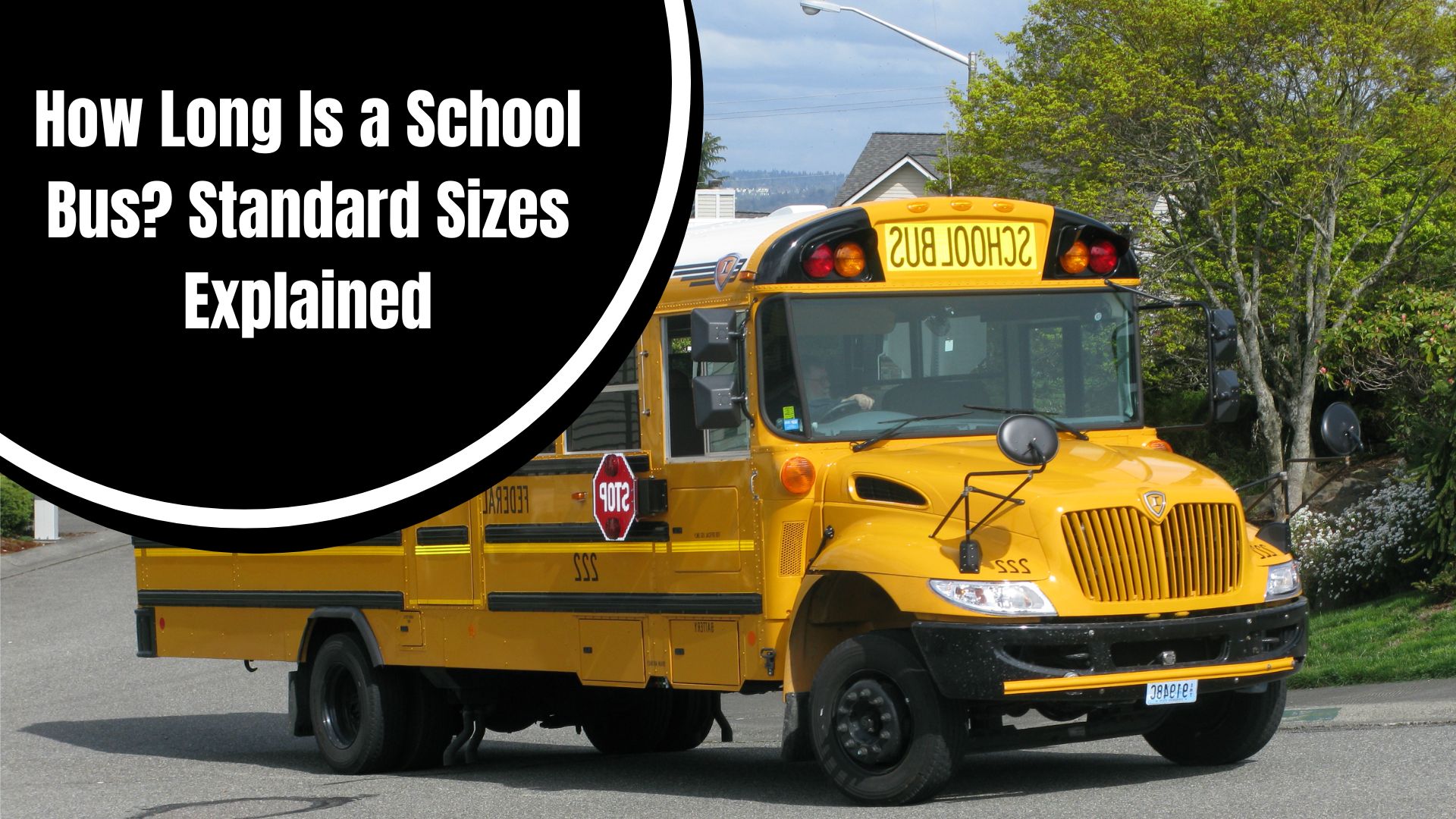
Understanding School Bus Types & Their Lengths
When people ask ” how long is a US school bus?” they’re not really getting a one-size-fits-all answer. There are actually a number of different types of buses that are used for school transportation, and each one has its own unique dimensions. Understanding what those dimensions are is actually pretty useful – it can help explain why some buses just seem massive while others don’t feel nearly as big.
1. Full-Size (Type D or Type C) School Buses
The full-size school buses are probably the type of bus most people can picture in their heads – you know, the classic yellow bus. These buses can generally accommodate 60-90 students, which will depend on the exact configuration.
- standard length: 35-45 feet (10.5-13.7 meters – again, it is a big difference when you consider the real size of an SUV or sedan, only ten to thirteen feet long!)
- width: about 8-8.5 feet (2.4-2.6 meters)
- height: about 10-11 feet (3-3.3 meters)
- seating plan: typical 12-15 rows of two or three students each.
The longer school buses are generally used for the routes with the highest ridership, like school districts in really urban areas. And let’s put things in perspective – a full-size bus is just huge compared to most SUVs and sedans, which are roughly half that length – 15-18 feet.
2. School Buses: The Compact Kind (Type A)
Short buses are a godsend for navigating narrow city streets or specialized routes, like those for kids with special needs or smaller schools. They are not necessarily the largest, yet they are good and can comfortably transport a fair amount of students.
- Standard length: clocks in at 20–30 feet (give or take 6–9 meters)
- Width: usually around 8 feet (2.4 meters give or take a bit)
- Height: typically around 9–10 feet (2.7–3 meters high)
- Seats: anywhere from 8 to 30 passengers, depending on the layout
What a lot of people don’t realize is that these “short buses” are still longer than your average delivery truck. We’ve all been there – trying to squeeze past one in a suburban neighborhood and thinking, “yep, these can feel a lot longer than they seem”.
3. Mini Buses
Mini buses are even tinier and often used for small private schools, daycares or special routes. They’re perfect for carrying a dozen or so passengers – up to 25 if you pack ’em in.
- Standard length: comes in at 15–20 feet (give or take 4.5–6 meters)
- Width: usually no more than 7–8 feet (2.1–2.4 meters)
- Height: typically around 8–9 feet (2.4–2.7 meters high)
These mini buses are actually shiners on narrow roads and routes that require one to be in a position to squeeze through narrow areas as opposed to transporting a full size load.
The Average Length of a School Bus
So you’re wondering “how long is the average school bus?” Well, it depends on whether you’re talking about full-size buses or all types put together.
- Full-size buses: clock in at around 40 feet (12.2 meters)
- Short buses: come in at about 25 feet (7.6 meters)
- Overall average (mix of all types): somewhere around 33–35 feet (10–10.7 meters)
That’s why school bus drivers need serious training – it’s not exactly a joke trying to navigate something twice the length of your own car
School Bus Size Dimensions in Feet – The Quick Lowdown
Here are the basics to remember:
| Bus Type | Length (feet) | Width (feet) | Height (feet) | Typical Seats |
| Full-size | 35–45 | 8–8.5 | 10–11 | 60–90 |
| Short bus | 20–30 | 8 | 9–10 | 8–30 |
| Mini bus | 15–20 | 7–8 | 8–9 | 12–25 |
From hands on experience, knowing these dimensions can actually be pretty helpful in planning parking, navigating roads or even figuring out how you’d film a scene with a school bus in it.
How Long is a School Bus Compared to a Car? – A Reality Check
Sedans are pretty standard – usually about 15 – 16 feet in length. But the big buses are a different thing, some of them even reaching 45 feet. It is about 3 times the length of a conventional car. The shortest bus at 25 feet is still 1.5 times the length of your average car.
That is why when people pass a school bus or park near it, they get so nervous.
You really do need to start thinking in terms of “bus lengths” rather than car lengths. And if you’re driving a small vehicle, turning behind a bus in a two-lane street can feel like you’re navigating an obstacle course.
Why School Buses are so Long
Ever wondered why school buses are just so blasted long ? The answer is pretty straightforward: capacity and safety.
- Cramming in as many students as possible: Longer buses can carry more students which means fewer trips and lower operational costs for the school district.
- Safety buffers: A longer bus creates a bigger gap between traffic and kids when you’re picking up or dropping off students – which is vitally important.
- Visibility for other drivers: Being longer and brightly coloured, the bus is going to be way more noticeable to other drivers.
But what lots of students don’t know is that being longer also has a big advantage – it’s all about efficiency. A single full-size bus route can serve the same amount of students as two or three smaller buses, reducing traffic and fuel usage.
How Many Seats are in a School Bus?
This depends on what type of bus we’re talking about
- Full size bus: 60 to 90 seats
- Short bus: 8 – 30 seats
- Mini bus: 12 – 25 seats
Seats are usually bench style which can hold 2 or 3 kids per row. Just keep in mind the exact amount can vary depending on whether it’s a special needs bus or if it has room for equipment like wheelchair lifts.
How Long Is A School Bus In Meters?
If you’re one of those people who prefers to think in metric, I’ve got the conversion for you:
- Full-sized buses: they’re usually between 10.5 and 13.7 metres long
- Short buses: we’re talking 6 to 9 metres here
- Mini buses: 4.5 – 6 metres is what you can normally expect
Still feels a bit long when you think about how one of those things is parked on your street doesn’t it?
Practical Tips for Not Crashing Into A School Bus
- Leave some space: try to keep at least 20 feet behind any school bus, especially when it’s slowing down.
- Keep out of the way: don’t forget that big buses need a good deal of space to turn about, and you had better avoid overturning the road.
- Park sensibly: if you’re parking near a bus, check out both the front and back of the bus – they can stretch out farther than you’d think.
- Be aware of their weight: the longer the bus, the heavier it is – so don’t cut in front of one unless you’re prepared to wait
Following these basic tips can mean a safer commute for everyone – trust me, I’ve been there…
Mistakes People Make About School Bus Sizes
- Assuming all buses are the same size: not so – those short and mini ones can come as a bit of a surprise.
- Forgetting about overhangs: people often forget that a bus sticking out from a corner can catch you off guard.
- Not checking the height: if you’re driving a low-slung vehicle, be aware that the roof on a full-sized bus is a fair bit higher up.
It’s easy to avoid these common mistakes if you know the normal size of a school bus.
FAQs
Q1: How long is a school bus, anyway?
A1: Typically, full-size buses are 35 to 45 feet long, and short buses are 20 to 30 feet long.
Q2: What’s the difference between a regular big school bus and a short one?
A2: Full-size buses hold 60 to 90 kids and are 35 to 45 feet long. Short buses carry way fewer (8-30 kids) and are 20 to 30 feet long.
Q3: How long are school buses compared to the average car?
A3: A full-size school bus is roughly three times as long as a standard car – fifteen feet. Short buses are about 1.5 times longer than a car.
Q4: What’s with school buses being so long?
A4: It’s because they’re designed to get as many kids in safely as possible, as well as being super practical for loading/unloading.
Q5: How many seats are on a school bus?
A5: Well, that varies: full size have 60 to 90 seats, short buses have 8 to 30, mini buses 12 to 25 – depending on just what they’re for and what they were designed to do.
Conclusion
So far and so good, what is the length of a school bus in a nutshell? To be honest, it varies depending on the type. Short buses are about 20 to 30 feet long, while the majority of large buses are 35 to 45 feet long. It’s all done for a reason, which is to get as many children in as safely and effectively as possible.
The next time you see a school bus in your neighborhood, drive by one, or park next to one, stop and consider how much work goes into its design. From seats to overhangs, every square inch serves a purpose.
And let’s be honest, knowing these numbers makes navigating around those yellow monsters on a narrow street a heck of a lot less intimidating.
We here at Proper Education care so much about your educational success. We have written many helpful guides, like the exam preparation tips, to give solutions to a lot of student problems.
Recommended Guides:
When does school start for real?
Best Free Resources for Nigerian Students Preparing for Exams