
Scoring a perfect 1600 on the SAT is not child’s play, but easy for those who know how to get 1600 on SAT. It is entirely possible for those who made use of the right approach. It’s not just about studying harder; it’s about studying smarter, understanding the test inside out, and consistently practicing with precision. This guide on how to get 1600 on SAT will break down exactly how to get 1600 on SAT, providing actionable strategies, step-by-step plans, and insider tips that top scorers use.
Question: How to get 1600 on SAT: What is the Complete Prep Plan for Top Score?
Answer: To get 1600 on the SAT, focus on mastering every concept, practicing with real SAT questions, taking timed full-length tests, analyzing mistakes, and refining test strategies consistently.
Understanding the SAT Structure
We won’t just move into the strategies; you must understand the SAT’s layout first. The reason is that the SAT has three main sections, and they are explained as follows:
- Evidence-Based Reading and Writing (EBRW)
- Reading (52 questions, 65 minutes)
- Writing & Language (44 questions, 35 minutes)
- Math
- No Calculator (20 questions, 25 minutes)
- Calculator Allowed (38 questions, 55 minutes)
- Optional Essay (no longer required by most colleges but still offered)
Why this matters: Knowing the number of questions, timing, and scoring helps you create a prep plan that focuses on efficiency and accuracy, the two keys to a 1600.
How to Get 1600 on SAT: Complete Prep Plan for Top Score
Want to learn how to get 1600 on SAT? Check out the steps below for a complete prep plan.
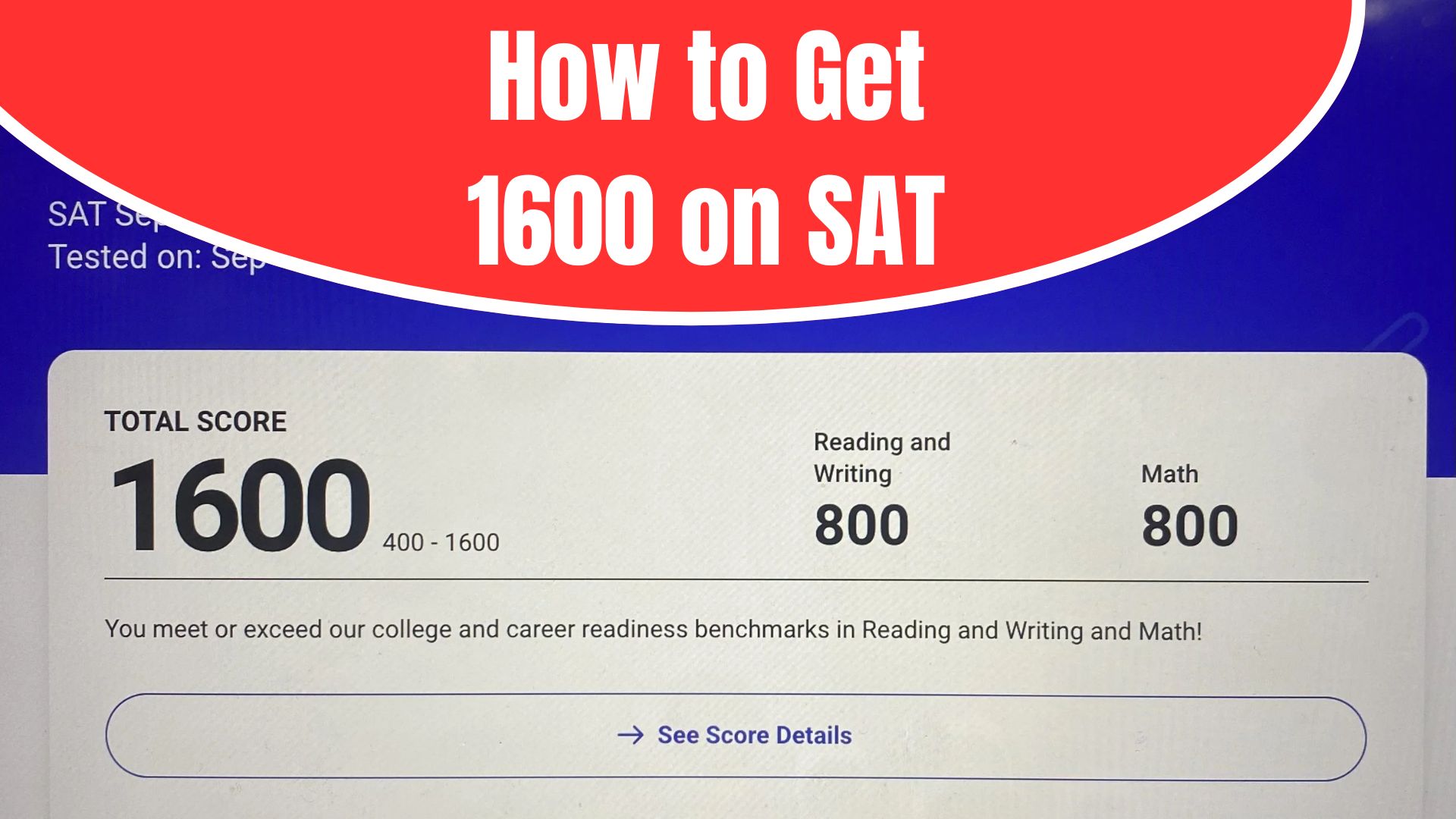
Step 1: Diagnose Your Starting Point
You can’t reach a perfect score without understanding your baseline.
- Take an official full-length SAT practice test under timed conditions.
- Record your scores for each section and note the types of questions that give you trouble.
- Identify patterns: Is it reading comprehension, grammar rules, or tricky math problems?
Tip: Use the College Board’s official practice tests—they mirror real SAT difficulty.
Step 2: Master SAT Math
Math is arguably the most “learnable” section. Here’s how to dominate it:
2.1 Focus on Core Topics
Prioritize topics that appear most frequently:
- Algebra (linear equations, systems, inequalities)
- Advanced Math (quadratics, functions, polynomials)
- Geometry & Trigonometry (circles, triangles, angles)
- Data Analysis & Problem Solving (ratios, percentages, probability)
Tip: Avoid wasting time on rare topics like complex numbers unless you’re already scoring high.
2.2 Build Problem-Solving Speed
- Practice timed sets of 10–15 questions.
- Learn shortcuts (mental math, estimation, plug-in strategies).
- Memorize formulas—you’ll save precious minutes.
2.3 Analyze Every Mistake
- Keep a math error log.
- Note why you got a question wrong (misread, concept error, calculation).
- Retest yourself on similar problems until errors disappear.
Step 3: Conquer Reading and Writing
EBRW requires a mix of comprehension, vocabulary, and grammar mastery.
3.1 Evidence-Based Reading Strategies
- Read actively: Summarize passages in your own words.
- Annotate: Circle main ideas and note tone/purpose.
- Practice question types: Main idea, inference, vocabulary in context, and evidence support.
Tip: Reading 2–3 high-quality articles daily (The Atlantic, New York Times, Scientific American) improves speed and comprehension naturally.
3.2 Writing & Language Tips
- Master grammar rules: Subject-verb agreement, punctuation, parallel structure, pronoun clarity.
- Focus on conciseness: SAT often tests unnecessary words.
- Practice editing passages under time pressure to simulate real test conditions.
Step 4: Build a Study Schedule
A strategic, realistic schedule is crucial.
Sample 12-Week Prep Plan for a 1600 Score:
| Week | Focus | Key Actions |
| 1-2 | Diagnostic & Core Review | Take practice test, identify weak areas |
| 3-5 | Math & Reading | Daily drills, error logs, timed practice |
| 6-8 | Advanced Practice | Full-length tests weekly, refine strategies |
| 9-10 | Targeted Weak Areas | Focus on hardest question types |
| 11 | Simulated Testing | Full SATs under timed conditions |
| 12 | Final Review | Quick notes, formulas, grammar rules, mental prep |
Tip: Consistency beats cramming. 2–3 focused hours daily is better than 6–8 hours once a week.
Step 5: Take Full-Length Practice Tests
Full-length practice is essential for top scorers.
- Simulate real test conditions: no phone, timed sections, breaks exactly as on test day.
- Review every wrong answer, understand why you missed it, and correct the logic.
- Track section-by-section improvement—aim for 1–2 points gain per test.
Pro Tip: College Board’s SAT practice tests are closest to the real exam in difficulty and style.
Step 6: Learn Smart Test-Taking Strategies
Even perfect knowledge needs strategy:
- Answer every question: No penalty for guessing.
- Skip and return: Don’t waste time on impossible questions.
- Process of elimination: Narrow options first before committing.
- Pace yourself: Keep an eye on time per question—practice with a timer.
Example: On reading passages, spend 1–2 minutes skimming first, then answer questions while referring back to the text.
Step 7: Build Mental Stamina
A perfect SAT score isn’t just skill—it’s endurance.
- Take long practice tests weekly to train focus for 3+ hours.
- Simulate distractions to stay calm under stress.
- Develop pre-test routines: breakfast, hydration, short warm-up questions.
Tip: Stress management techniques like deep breathing or visualization improve performance dramatically on test day.
Step 8: Use the Right Prep Materials
Not all resources are created equal. Top scorers rely on:
- Official SAT Practice Tests (College Board)
- Khan Academy SAT prep (free, personalized)
- Targeted prep books: Erica Meltzer for reading & grammar, Dr. Steve Warner for math.
Avoid “shortcut” books that promise a perfect score in one week; they rarely work for great improvement.
Step 9: Track Progress and Adjust
- Keep a score tracker for every practice test.
- Compare weekly performance to goals.
- Adjust study focus—spend more time on weak areas and maintain strong areas.
Tip: By week 10, you should aim for scores consistently above 1500 before refining for perfection.
Step 10: Day Before and Test Day Tips
- Day before: Review quick notes, formulas, and grammar rules. No heavy studying.
- Test day: Eat a good breakfast, arrive early, bring snacks and water.
- Mindset: Visualize success, stay calm, and trust your preparation.
Common Mistakes to Avoid while Practicing to Get 1600 on SAT
- Ignoring weak sections – balance practice across all sections.
- Skipping timed practice – real SAT timing is strict.
- Over-reliance on shortcuts – focus on understanding concepts first.
- Neglecting mental health – stress and fatigue can lower scores.
Advanced SAT Strategies to Boost Your Score (How to Get 1600 on SAT)
Even after following a complete prep plan, many students wonder if there are extra strategies to push their SAT score from excellent to perfect. Here, we cover advanced SAT strategies, practical tips, and answer common questions that top scorers ask. This section ensures you don’t just aim for a high score—you maximize every point.
Advanced SAT Strategies for Maximum Score
1. Prioritize Question Types for High-Impact Gains
Not all SAT questions are equal. Some carry more weight for time spent:
- Reading: Evidence-based questions and main idea questions are often easier to answer quickly. Prioritize them first to save time.
- Math: Multi-step word problems usually take longer. Do the simpler questions first and return to complex problems.
- Writing & Language: Focus on frequently tested grammar rules. Skipping uncommon rules like double negatives can save time.
Pro Tip: Track which question types you miss most often. Create a micro-drill sheet for these. Practicing 5–10 of these questions daily can significantly boost your score.
2. The Art of Smart Guessing
Even perfect scorers guess occasionally. The key is strategic elimination:
- Remove obviously wrong answers first.
- If stuck, eliminate 1–2 options to increase your odds.
- Never leave questions blank. There’s no penalty for wrong answers.
Example: In math, if you can’t solve a problem quickly, plug in the multiple-choice answers instead of spending excessive time.
3. Time Management by Section
A perfect SAT score depends on finishing every section with confidence:
- Reading: ~1 minute per question; use passage skimming for faster comprehension.
- Writing & Language: ~45–50 seconds per question; underline keywords.
- Math No-Calculator: ~1 minute per question; skip lengthy calculations and come back later.
- Math Calculator: ~1.3 minutes per question; use estimation when possible.
Practice with timers and full-length simulations to internalize pacing.
4. Incorporate Active Review
Merely doing practice tests isn’t enough—you must analyze every mistake:
- Write down why each answer was wrong.
- Categorize errors: careless, conceptual, or timing-related.
- Retest only on these errors until your accuracy improves.
Active review turns mistakes into your most powerful learning tool.
5. Mental Conditioning for Peak Performance
Scoring 1600 requires focus and stamina:
- Practice long reading sessions to simulate fatigue.
- Use mindfulness or deep-breathing exercises before testing.
- Ensure proper sleep and nutrition on test day.
Top scorers train not just their knowledge but also their brain’s endurance.
Conclusion
Getting 1600 on the SAT is a realistic goal if you follow a structured, disciplined prep plan. Start with a diagnostic test, master math and EBRW concepts, take regular full-length practice tests, and refine your strategies consistently. Remember, perfection comes from understanding, not guesswork. Stick to this plan, track progress, and approach test day with confidence—your top score is achievable.
FAQs for How to Get 1600 on SAT
Here are carefully structured, highly searchable FAQs using the remaining keywords and long-tail variations:
1. What is the best step-by-step plan to get 1600 on SAT?
Answer: The most effective plan involves three phases: diagnostic testing, targeted skill-building, and full-length practice with active review. Start by identifying weak areas, then focus on high-yield topics in math, reading, and grammar. End with weekly timed full-length SAT tests, review every mistake, and adjust strategies based on patterns. This structured approach maximizes score gains efficiently.
2. How can I use a SAT reading and writing prep guide effectively?
Answer: Choose guides that provide practice passages, grammar exercises, and strategy tips. Read passages actively, annotate main ideas, and practice evidence-based questions. Regularly timed exercises and consistent review of errors help improve speed and accuracy. Integrate the guide into your daily prep for 30–60 minutes of targeted practice.
3. What tips help achieve a top SAT score?
Answer: Focus on:
- Prioritizing easy-to-moderate questions first
- Using process of elimination
- Practicing high-frequency topics
- Reviewing all mistakes actively
- Maintaining mental stamina with simulated full-length tests
Consistency and strategic preparation are more important than long hours of passive study.
4. Are there specific SAT strategies to improve math and reading scores?
Answer: Yes. For math, master formulas, practice multi-step problems, and estimate when stuck. For reading, summarize passages in your own words, highlight keywords, and practice skimming for efficiency. Using timed drills improves speed while retaining accuracy.
5. How to integrate a SAT prep plan into a busy schedule?
Answer: Focus on daily focused blocks rather than long, infrequent sessions. Even 2–3 hours of daily targeted practice—mixing math, reading, and writing—works better than 6–8 hours once a week. Schedule micro-drills for weaker areas, and use weekends for full-length timed tests and review.
Bonus Tip: Using Analytics to Predict Performance
Keep a progress tracker to monitor trends in your practice tests:
- Average score per section
- Time spent per question type
- Error types and frequency
By analyzing these trends, you can focus on high-leverage improvements and steadily approach a 1600.
At Proper Education, we care so much about your educational success. We have written many helpful guides, such as WAEC Guides, to provide solutions to many students’ problems. Feel free and be assured to get the very best from us as far as educational guides are concerned.
Recommended Guides:
How to raise SAT score fast and effectively
What is SAT R: Effective SAT R Strategies
How to Get a High SAT Score: Proven Strategies That Work
Pingback: How to Raise SAT Score: Expert Methods for Top Results
Pingback: What is SAT R: Everything You Need to Know Quickly
Pingback: How to Improve Craft and Structure SAT: Step-by-Step
Pingback: How to Get a Good SAT Score: Simple Guide to Succeed
Pingback: How to Improve SAT Score: Easy Strategies That Work Fast