
Your SAT score in 2026 is more than just a number; it tells colleges how prepared you are for academic success. The SAT Score Chart 2026 helps you understand where your score falls, what it means, and how competitive you are for college admissions, and this is indeed worth knowing.
So, if you are among those who have taken the SAT or are preparing for it, understanding how scores are calculated and interpreted can give you a huge advantage.
Question: SAT Score Chart 2026: What is the best way to understand your results?
Answer: The SAT Score Chart 2026 shows how your total score (400-1600) compares to performance levels and percentiles, helping you understand your academic standing and college readiness.
What Does the SAT Score Chart 2026 Mean?
The SAT Score Chart 2026 is a visual or tabular representation that explains how SAT scores are distributed and categorized.
It helps you:
- Know whether your score is low, average, or high
- Compare your performance with other test-takers
- Understand your college admission chances
- Set realistic score improvement goals
Think of it as a roadmap; it shows where you are now and where you need to go.
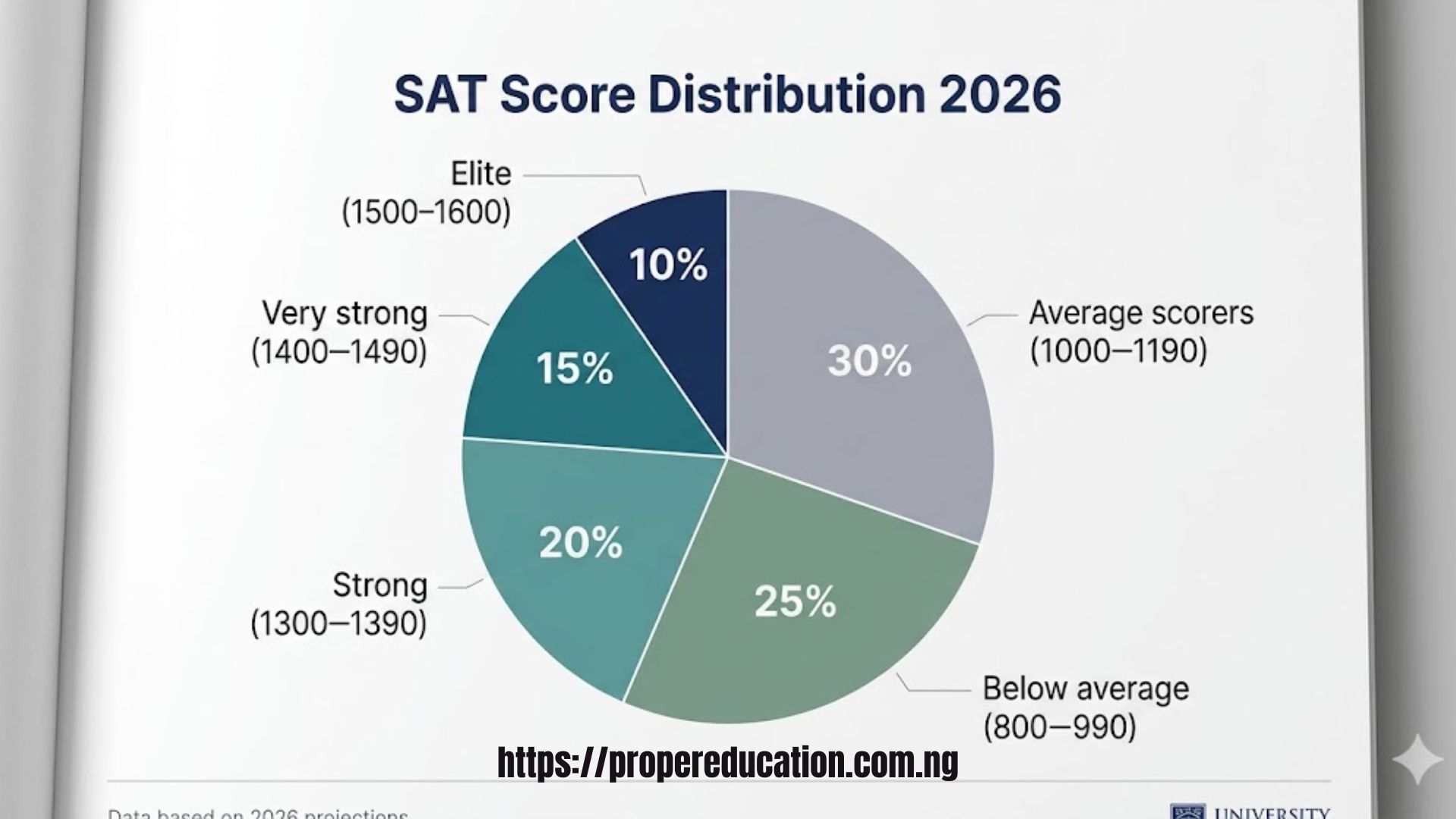
SAT Scoring System Explained
Before diving into the SAT Score Chart 2026, you need to understand how scoring works.
Total Score Breakdown (400–1600)
Your SAT score is made up of two main sections:
- Evidence-Based Reading and Writing (EBRW)
- Math
Each section is scored between:
- 200 to 800
Final Score Calculation:
- Minimum Score: 400
- Maximum Score: 1600
Example:
- Reading & Writing: 650
- Math: 700
Total Score = 1350
SAT Score Chart Table (Detailed)
Below is a simplified version of the SAT Score Chart 2026 to help you understand score ranges and what they mean.
| Score Range | Performance Level | Percentile Range | Meaning |
| 1500–1600 | Excellent | 98th–99th | Top-tier performance |
| 1400–1490 | Very Strong | 94th–97th | Highly competitive |
| 1300–1390 | Strong | 86th–93rd | Above average |
| 1200–1290 | Good | 74th–85th | Solid performance |
| 1000–1190 | Average | 40th–73rd | Meets basic expectations |
| 800–990 | Below Average | 10th–39th | Needs improvement |
| 400–790 | Low | 1st–9th | Significant improvement needed |
Score Ranges and Performance Levels
1. Top Scores (1400–1600)
- Elite performance
- Competitive for Ivy League and top universities
- Strong academic readiness
2. Above Average Scores (1200–1390)
- Good chances at competitive colleges
- Shows solid understanding of subjects
3. Average Scores (1000–1190)
- Meets general college requirements
- May limit options for top schools
4. Below Average Scores (Below 1000)
- Indicates gaps in knowledge
- Requires focused preparation
What Is a Good SAT Score in 2026?
A “good” score depends on your goals, but generally:
- 1200+ = Good
- 1300+ = Very Good
- 1400+ = Excellent
College Acceptance Benchmarks
| College Type | Recommended SAT Score |
| Ivy League | 1450–1600 |
| Top Universities | 1350–1500 |
| Competitive Colleges | 1200–1350 |
| Average Colleges | 1000–1200 |
Tip: Always aim above the average score required for your target school.
How Colleges Interpret SAT Scores
Colleges don’t just look at your total score they analyze it deeply.

What Admissions Officers Consider:
- Section scores (Math vs Reading)
- Score consistency
- Superscoring (best section scores combined)
- Percentile ranking
Competitive vs Average Schools
Competitive Schools:
- Expect scores above 1350
- Focus on top percentiles
- Compare applicants closely
Average Schools:
- Accept scores between 1000 and 1200
- Consider other factors like GPA and extracurriculars
SAT Score Chart 2026 and Percentiles Explained
Percentiles show how your score compares to others.
Example:
- 90th percentile = You scored higher than 90% of students
Why Percentiles Matter:
- Helps colleges rank applicants
- Shows your relative performance globally
- More important than raw scores in some cases
How to Improve Your Score (Step-by-Step Guide)
Improving your SAT score is absolutely possible with the right strategy.
Section-Wise Improvement Plan
1. Reading & Writing Section
- Practice comprehension daily
- Learn grammar rules
- Focus on vocabulary in context
Tip: Read newspapers, blogs, and academic texts regularly.
2. Math Section
- Master basic concepts (algebra, geometry)
- Practice problem-solving daily
- Focus on weak areas
Tip: Don’t just solve understand why answers are correct
3. Practice Tests
- Take full-length tests weekly
- Analyze mistakes carefully
- Track progress over time
4. Time Management
- Learn to answer questions faster
- Skip difficult questions and return later
5. Use Official Resources
- Practice with real SAT questions
- Use digital SAT platforms
SAT Score Conversion Tips
Sometimes you’ll see raw scores converted into scaled scores.
Key Tips:
- Raw score = number of correct answers
- Scaled score adjusts for test difficulty
- No penalty for wrong answers
Understanding Percentiles (Deep Insight)
Here’s a quick example:
| Score | Percentile |
| 1550 | 99th |
| 1400 | 95th |
| 1200 | 75th |
| 1000 | 50th |
Insight:
A small score increase at higher levels can significantly boost your percentile.
Common Mistakes Students Make
Avoid these if you want a better score:
- Not understanding the SAT Score Chart 2026
- Ignoring weak subjects
- Skipping practice tests
- Poor time management
- Studying without a plan
Pro Tips to Score 1400+
- Focus on accuracy before speed
- Review mistakes daily
- Use timed practice sessions
- Take at least 10 full mock tests
- Stay consistent (study 1–2 hours daily)
SAT Score Chart 2026: Real-Life Example
Let’s say:
- You scored 1250
- Percentile: ~80th
What It Means:
- You performed better than 80% of students
- You’re competitive for many universities
- With improvement, you can reach top-tier schools
SAT Score Chart 2026: Strategic Score Targeting for College Admission Success
Understanding the SAT Score Chart 2026 is not just about knowing your score range—it is about using that information to make smart academic decisions that improve your chances of admission into the right college. Many students stop at checking whether their score is “good” or “bad,” but successful applicants go further by using score data strategically.
This section explains how to interpret your score like an admissions officer, how to set realistic targets, and how to use the SAT score chart to build a strong college admission strategy.

Why Most Students Misunderstand the SAT Score Chart 2026
One major weakness among test-takers is treating SAT scores as a final result instead of a comparison tool.
Most students:
- Focus only on total score (e.g., 1200 or 1350)
- Ignore percentile ranking
- Do not match scores with college requirements
- Underestimate section score balance
But the SAT Score Chart 2026 is designed to show more than numbers—it shows positioning.
For example:
- A 1300 score in a low-testing year may not be as competitive as a 1300 in a high-testing pool.
- A student with 1250 but strong Math (750) may outperform a 1300 balanced scorer in engineering programs.
This is why understanding context is more important than memorizing ranges.
SAT Score Chart 2026 and College Selection Strategy
Instead of asking “Is my score good?”, the smarter question is:
“What colleges accept students in my SAT score band?”
Smart Application Strategy by Score Range
1. SAT Score: 1450–1600 (Elite Range Strategy)
If you fall into this category, your focus should be:
- Apply to highly selective universities
- Target merit scholarships
- Strengthen extracurricular portfolio
- Apply early decision where possible
Strategy insight:
At this level, SAT is no longer the problem—your essays and achievements become the deciding factor.
2. SAT Score: 1300–1440 (Competitive Strategy Range)
This is a highly flexible range in the SAT Score Chart 2026.
You should:
- Apply to mix of reach and match schools
- Highlight leadership activities
- Retake SAT only if aiming for Ivy-level schools
Common mistake to avoid:
Many students in this range apply too low and miss better opportunities.
3. SAT Score: 1100–1290 (Growth Strategy Range)
This is the most misunderstood category.
You are not weak you are in an improvement range.
Best strategy:
- Apply to moderately selective colleges
- Retake SAT after focused preparation
- Strengthen Math or Reading depending on weakness
Key insight:
A 100-point increase here can significantly change your college tier.
4. SAT Score Below 1100 (Foundation Strategy Range)
This range requires a structured approach:
- Focus on skill rebuilding, not memorization
- Start with basic algebra, grammar rules, and reading comprehension
- Use timed practice gradually
Important truth:
Colleges also consider improvement trend, not just final score.
SAT Score Chart 2026: Hidden Factor Colleges Don’t Explain
Most guides ignore this, but admissions officers quietly look at:
1. Score Consistency
A student with:
- Math: 700
- Reading: 700
Is often preferred over:
- Math: 800
- Reading: 500
Why? Balance shows academic readiness across disciplines.
2. Score Growth Trend
Colleges value:
- 900 → 1150 → 1300 progression
More than:
- 1300 stagnant score
This shows discipline and improvement ability.
3. Superscoring Advantage
Many universities use superscoring, meaning:
- Best Math score + best Reading score across attempts
This allows students to:
- Retake SAT strategically
- Improve one section at a time
How to Use SAT Score Chart 2026 to Build a Study Plan
Instead of studying randomly, top scorers reverse-engineer their preparation.
Step 1: Identify Current Band
Check your score range from the SAT chart.
Step 2: Set Target Band
Example:
- Current: 1150
- Target: 1350
Step 3: Break Down Section Goals
- Reading: +80 points
- Math: +120 points
Step 4: Weekly Execution Plan
- 3 days Math focus
- 2 days Reading & Grammar
- 1 full practice test
- 1 review day
Common Weaknesses in SAT Score Improvement Guides (Your Advantage)
Most competitors fail because they:
- Only explain score ranges without strategy
- Don’t connect scores to real college outcomes
- Ignore percentile importance
- Do not show improvement roadmap
- Overuse generic advice
SAT Score Chart 2026 and Career Path Awareness
Many students don’t realize SAT scores also influence:
- Scholarship eligibility
- Course selection options
- International admission chances
For example:
- STEM programs prefer higher Math scores (700+)
- Humanities programs prioritize Reading & Writing strength
So your SAT score is not just admission—it affects your academic direction.
Smart Retake Strategy Based on SAT Score Chart 2026
A retake is not always necessary.
Retake if:
- Your score is below target college requirement
- One section is significantly weaker
- You have a clear improvement plan
Do NOT retake if:
- You already meet target percentile
- Improvement is unlikely without major effort
- Time is better spent on applications
Final Thoughts on SAT Score Chart 2026
Understanding the SAT Score Chart 2026 gives you clarity, direction, and confidence. It helps you know exactly where you stand and what steps to take next.
Your SAT score does not define your future but improving it can open more doors.
SAT Score Chart 2026: What Most Students Realize Too Late
The SAT Score Chart 2026 is not just about your final score. Many students focus only on the total number, but colleges look deeper than that. They care about what your score shows in terms of consistency, improvement, and readiness for higher studies.
To understand your result properly, it helps to look at how SAT scores are actually interpreted in admission decisions.
Why Your SAT Score Is Not the Full Story
When students check the SAT Score Chart 2026, they usually focus only on the final number. But colleges do not see your score as just a single result. They look at the story behind it, especially your improvement pattern and consistency.
Colleges pay attention to:
- Improvement from one attempt to another
- Balance between Math and Reading/Writing
- Consistency in performance across sections
- Overall academic effort and progress
A student who improves steadily is often viewed more positively than someone with a flat score history, even if the final numbers are similar.
Common Mistakes Students Make with SAT Score Chart 2026
Many students misunderstand how the SAT Score Chart 2026 should guide their preparation and decisions.
Common mistakes include:
- Choosing schools without checking their SAT requirements
- Ignoring weak sections and focusing only on total score
- Not understanding percentile differences
- Stopping preparation after reaching an “average” score
- Avoiding retests even when improvement is possible
These mistakes often reduce admission opportunities even when the student has potential for higher performance.
How to Use SAT Score Chart 2026 the Right Way
The SAT score chart becomes powerful when used as a planning tool rather than just a result guide.
A smarter approach:
- Start by identifying your target universities
- Research their average SAT score expectations
- Compare your current score band with those requirements
- Build a focused study plan based on the gap
This method ensures every study session is purposeful and aligned with real admission goals.
How Colleges Really Evaluate SAT Scores
Colleges do not rely on SAT scores alone. They combine multiple academic indicators to assess applicants.
Key factors include:
- How your score compares to school averages
- Section strength (Math vs Reading/Writing)
- Progress across multiple test attempts
- Academic record alongside SAT performance
Because of this, two students with identical SAT scores may still receive different admission outcomes.
Final Insight Most Students Overlook
Your SAT score is not a final label. It is a reflection of where you currently stand in your academic readiness.
A typical improvement path looks like this:
- First attempt: understanding the exam structure
- Second attempt: identifying weak areas and correcting them
- Final attempt: refining strategy and maximizing performance
Colleges often respect improvement because it shows discipline, adaptability, and commitment to learning.
Conclusion
The SAT Score Chart 2026 is a powerful tool that helps you interpret your results, compare your performance, and plan your next move. Whether your score is high or needs improvement, what matters most is your willingness to grow.
Stay consistent, practice smart, and don’t give up. Every point increase brings you closer to your dream school.
FAQs for SAT Score Chart 2026
What is the SAT Score Chart 2026 used for?
It is used to understand SAT score ranges, performance levels, and college competitiveness.
What is a good SAT score according to the SAT Score Chart 2026?
A good score is generally 1200+, while top competitive schools require 1350+.
How do colleges interpret SAT scores?
Colleges use SAT scores for admission ranking, scholarship decisions, and academic readiness evaluation.
What percentile is 1300 on the SAT Score Chart 2026?
A 1300 typically falls around the 85th–90th percentile depending on the test year.
Can I improve my SAT score from 1100 to 1400?
Yes, with structured preparation, consistent practice, and targeted section improvement.
At Proper Education, your academic success is our priority. We create practical guides, including Exam Preparation guides, Study Techniques, and student problem guides, to help students overcome challenges and achieve better results.
Recommended Guides:
SAT Registration 2026: Dates, Fees & How to Apply
SAT Dates 2026: Exam Schedule & Registration Guide
Pingback: SAT Dates 2026 – Exam Schedule & Registration Deadlines